
Xếp hạng: ⭐⭐⭐⭐⭐
Tỷ lệ thắng: 99%


IMPORTANT DISCLAIMER AND WARNING:
The following article provides information regarding the development of integrated entertainment resorts and gaming facilities on Phu Quoc Island, Vietnam. This content is intended solely for informational and educational purposes for travelers, investors, and industry observers interested in tourism trends.
The information presented here does not constitute an endorsement, encouragement, or promotion of any form of real-money gaming activities. Laws and regulations regarding entry to these facilities, particularly for Vietnamese citizens, are strict and subject to change by government authorities. Participation in gaming activities involves financial risk. Readers are advised to research local laws thoroughly and engage in any leisure activities responsibly and within their financial means.
Phu Quoc Gaming Hub Rise: Vietnam’s Mini Macau
Table of Contents
For decades, Phu Quoc was known primarily for its incredibly clear turquoise waters, world-class peppercorns, and pungent fish sauce. It was a sleepy, tropical escape off the southern coast of Vietnam and Cambodia. However, over the last ten years, a dramatic transformation has taken place. Driven by massive infrastructure investment and a strategic shift in government tourism policy, the island is rapidly emerging as Southeast Asia’s newest premier entertainment destination. At the center of this evolution is the burgeoning Phu Quoc gaming hub, a development that is drawing inevitable comparisons to established giants like Macau and Singapore.
The rise of the Phu Quoc gaming hub is not just about the addition of tables and slot machines; it represents a fundamental pivot in Vietnam’s approach to high-end leisure. By creating large-scale integrated resorts that combine luxury accommodation, theme parks, golf courses, and international-standard gaming facilities, Phu Quoc is positioning itself to capture a significant share of the lucrative Asian tourism market.
This article explores the multifaceted rise of the Phu Quoc gaming hub, examining the regulatory breakthroughs that made it possible, the key players driving its growth, and the profound economic impact this “Mini Macau” aspiration is having on the region.
From Pearl Island to Entertainment Capital: The Evolution
To understand the significance of the current Phu Quoc gaming hub, one must appreciate the speed of the island’s development. Until relatively recently, access was limited, and infrastructure was basic. The Vietnamese government, recognizing the island’s potential to rival destinations like Phuket or Bali, designated Phu Quoc as a special economic zone.
This designation unlocked billions of dollars in investment. A new international airport was constructed, capable of handling millions of visitors annually. Visa exemptions for international tourists arriving directly to the island were implemented, lowering barriers to entry. Smooth highways replaced dirt roads, connecting the north and south of the island.
These foundational changes set the stage for mega-developers like Vingroup and Sun Group to move in. While their initial focus was on hotels and theme parks, the long-term vision always included a centerpiece that would drive year-round, high-spending tourism: the Phu Quoc gaming hub. The goal was to create a destination where visitors would stay longer and spend more, moving beyond the traditional “sun and sand” model toward a comprehensive entertainment experience.
The Catalyst: Vietnam’s Pilot Program for Local Players
The true turning point for the Phu Quoc gaming hub—and what truly gives weight to the “Mini Macau” comparison—was a landmark shift in Vietnamese policy. Historically, gaming venues in Vietnam were strictly open only to holders of foreign passports. This severely limited the market potential, relying solely on international tourists and expatriates.
However, in a move designed to repatriate significant amounts of revenue that Vietnamese citizens were spending in neighboring countries like Cambodia and Singapore, the government authorized a pilot program. This program allowed qualifying Vietnamese citizens to enter specific domestic gaming venues.
Phu Quoc was selected as the primary location for this experiment. The Corona Integrated Resort became the first, and currently only, facility where locals meeting strict criteria—such as proving a minimum monthly income and purchasing an entry pass—could legally participate in table games and electronic gaming.
This regulatory breakthrough was the catalyst that ignited interest in the Phu Quoc gaming hub. Suddenly, the addressable market expanded exponentially. Investors saw the potential for a sustainable domestic revenue base that could supplement international tourism fluctuations. This unique status immediately elevated the importance of the Phu Quoc gaming hub within the national tourism strategy.
Inside the Corona Integrated Resort: The Anchor of the Hub
Currently, the heart of the Phu Quoc gaming hub is the vast complex known as the Corona Integrated Resort located on the scenic Long Beach in the island’s north. As the pioneer of the pilot program for locals, it sets the standard for what a Vietnamese integrated resort can be.
The scale of the facility is impressive, designed to compete with regional rivals. It features hundreds of tables offering popular formats like Baccarat, Blackjack, and Roulette, alongside thousands of state-of-the-art electronic gaming machines. The floor is designed with the opulent aesthetic expected of a world-class venue, catering to both mass-market players and high-rollers in exclusive VIP salons.
Currently, the success of the entire concept of a Phu Quoc gaming hub rests on the performance of this venue. Its ability to attract international VIPs while successfully managing the domestic pilot program is being closely watched by policymakers and investors alike. The venue operates 24/7, providing an engine for the nighttime economy that was previously non-existent on the island. The sheer volume of activity generated here confirms its status as the anchor of the developing Phu Quoc gaming hub.
Beyond the Tables: A Holistic Integrated Resort Experience
A successful modern gaming hub cannot rely on tables alone. The “Macau model,” which Phu Quoc seeks to emulate, is based on the Integrated Resort (IR) concept. An IR is a multi-dimensional destination where gaming is just one component of a broader entertainment ecosystem.
The Phu Quoc gaming hub is surrounded by precisely this type of ecosystem, primarily driven by Vingroup in the northern part of the island. The Corona complex is seamlessly connected to high-end accommodation options like the Radisson Blu and various Vinpearl luxury villas.
Crucially, the hub is flanked by massive non-gaming attractions. VinWonders Phu Quoc is one of the largest theme parks in Vietnam, offering world-class rides and shows. Adjacent to it is the Vinpearl Safari, an open-range zoo that attracts families in droves. Furthermore, a 18-hole international golf course caters to the premium leisure market.
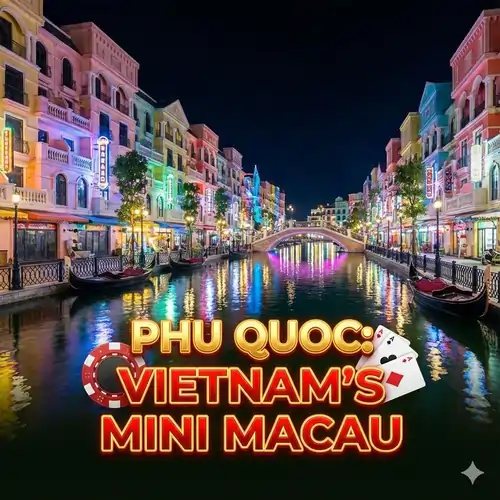
Also hard to miss is the “Grand World” complex. Designed as a “sleepless city,” featuring Venice-inspired canals and architecture, it provides endless retail, dining, and cultural performance spaces just minutes from the gaming floors.
This holistic approach is vital for the sustainability of the Phu Quoc gaming hub. It ensures that while one family member might be engaged at the tables, others are enjoying the water park, the safari, or fine dining. This diversification broadens the demographic appeal and encourages multi-night stays, solidifying Phu Quoc’s reputation as a comprehensive resort destination rather than just a gaming outpost.
The “Mini Macau” Comparison: Ambition vs. Reality
The label “Vietnam’s Mini Macau” is frequently applied to the Phu Quoc gaming hub, but how accurate is this comparison?
The comparison stems from the ambition. Like Macau, Phu Quoc is an island utilizing special policy frameworks to build an economy centered on high-value tourism and entertainment. Both seek to attract high-net-worth individuals from across Asia, particularly China, South Korea, and Japan. The concentration of luxury hotels surrounding a central gaming facility is a direct parallel to the Cotai Strip model.
However, there are significant differences in scale and maturity. Macau is the undisputed global heavyweight in terms of gaming revenue, with decades of history and dozens of massive concessions. The Phu Quoc gaming hub is in its infancy, currently reliant on a single major venue licensed for locals.
Furthermore, the aesthetic is different. While Macau is dense and urban, the Phu Quoc gaming hub is spread out over a lush, tropical landscape, leveraging its natural beaches and environment as a core selling point that Macau lacks. Phu Quoc is aiming for a “tropical resort with world-class gaming,” rather than a pure “gaming city.”
While it may never reach the sheer revenue volume of Macau, the “Mini Macau” moniker serves as a statement of intent. It signals to the world that the Phu Quoc gaming hub is operating at international standards and is open for serious business.
Economic Ripples: How the Hub Reshapes the Region
The development of the Phu Quoc gaming hub has sent profound economic shockwaves across the island and the surrounding Kien Giang province. The most immediate impact has been in real estate. Land values, particularly in the north near the integrated resorts and in the south near Sun Group’s developments, skyrocketed as investors speculated on the island’s future trajectory.
Job creation has been massive. An integrated resort requires thousands of staff, from dealers and pit supervisors to hospitality workers, chefs, and security personnel. The Phu Quoc gaming hub has created a demand for specialized skills, leading to new training programs and higher average wages compared to traditional agricultural or fishing roles on the island.
The ripple effect extends to supporting industries. Construction companies, food suppliers, logistics firms, and transportation services have all seen a surge in demand to support the operations of the vast resort complexes. The visa exemption policy, combined with the allure of the Phu Quoc gaming hub, has driven consistent increases in international arrivals, providing a steady stream of foreign currency.
However, this rapid development is not without challenges. The influx of workers and tourists puts strain on the island’s environment, water resources, and waste management systems, requiring ongoing government attention to ensure the growth of the Phu Quoc gaming hub is sustainable.
Future Horizons: Expanding the Landscape
The story of the Phu Quoc gaming hub is only just beginning. The current success of the pilot program at the Corona resort will likely determine the future landscape. If the government deems the pilot successful in terms of economic benefit and social order management, it could lead to the expansion of licenses or the permanency of the local-entry rules.
There is constant speculation about potential new players entering the Phu Quoc gaming hub. Other major developers with land banks on the island are undoubtedly watching the sector closely, hoping to secure their own licenses to operate similar integrated resorts.
Furthermore, infrastructure improvements continue. Plans to expand the airport further and improve the island’s port facilities to accommodate larger cruise ships are in motion. These developments are crucial for feeding the capacity of the growing Phu Quoc gaming hub.
Looking ahead, the focus will likely shift toward refining the luxury offering, attracting even higher-tier VIP players, and ensuring that the service standards match the impressive hardware that has been built. The goal is to solidify the Phu Quoc gaming hub not just as a Vietnamese curiosity, but as a staple destination on the Asian global entertainment circuit.
FAQs About the Phu Quoc Gaming Hub
1. What makes Phu Quoc unique compared to other entertainment destinations in Vietnam?
The primary factor that makes Phu Quoc unique is its special economic zone status and, crucially, its selection for the pilot program allowing Vietnamese citizens to participate in gaming activities. While other cities have international gaming venues for foreigners, the Phu Quoc gaming hub is currently the only place where qualifying locals can legally join the action, significantly changing the market dynamics.
2. Can anyone enter the gaming facilities within the Phu Quoc gaming hub?
No, entry is highly regulated. Foreign passport holders (tourists and expats) can generally enter upon presenting valid identification showing they are over different age requirements (usually 18 or 21). For Vietnamese citizens, entry to the Phu Quoc gaming hub is restricted to those who are at least 21 years old, can prove a monthly income exceeding 10 million VND, and must purchase an entry ticket.
3. Are there other attractions besides gaming in these resort areas?
Absolutely. The “integrated resort” model is central to the Phu Quoc gaming hub. The main entertainment complexes are surrounded by, or directly connected to, massive non-gaming attractions. These include VinWonders theme park, Vinpearl Safari, Grand World (a retail and dining complex), 18-hole golf courses, beautiful beaches, and numerous fine dining restaurants and luxury spas.
4. How do I get to the major resorts in the Phu Quoc gaming hub?
The major integrated resorts that define the Phu Quoc gaming hub are primarily located in the northern part of the island, near Ganh Dau beach. They are easily accessible via taxi or private transfer from Phu Quoc International Airport, a journey that usually takes about 45 minutes to an hour. Many of the luxury hotels within the complex offer shuttle services for guests.
5. Is the “Mini Macau” comparison accurate?
It is accurate in terms of ambition and the integrated resort model, but different in scale and setting. Macau is a dense urban environment and the world’s largest gaming market. The Phu Quoc gaming hub is much newer, smaller in revenue scale, and is set within a sprawling, tropical beach environment. Phu Quoc aims to be a premium leisure destination with world-class gaming, rather than just a gaming city.
Conclusion
The transformation of a quiet island known for fish sauce into the dynamic Phu Quoc gaming hub is one of the most significant tourism developments in modern Vietnam. Through bold policy experiments—specifically allowing local participation—and billions of dollars in private investment, Phu Quoc has carved out a unique niche in the highly competitive Asian entertainment landscape.
While the “Mini Macau” moniker reflects its lofty aspirations, the island is developing a distinct identity. It is blending high-stakes leisure with tropical relaxation, family-friendly theme parks with exclusive VIP salons.
As infrastructure improves and the market matures, the Phu Quoc gaming hub looks set to remain a pivotal engine of economic growth for Vietnam and a compelling new destination for travelers across the globe. The rise of this island hub is a testament to Vietnam’s strategic vision to move up the tourism value chain, offering world-class integrated resort experiences on its own beautiful shores.
Related Posts:
- Corona Casino Phu Quoc Reviews
- Gi8 App Download
- Corona Casino Phu Quoc Games
- Vietlott 6/45 Odds
- Vietlott Mega 6/45 Odds Jackpot Probability
- Gi8 Ang Nhập
Minh Quân là Chuyên gia SEO với hơn 10 năm kinh nghiệm trong lĩnh vực iGaming, chuyên tối ưu hóa hiển thị tìm kiếm, thúc đẩy tăng trưởng tự nhiên và triển khai chiến lược dựa trên dữ liệu cho các nền tảng casino, cá cược thể thao và xổ số.